
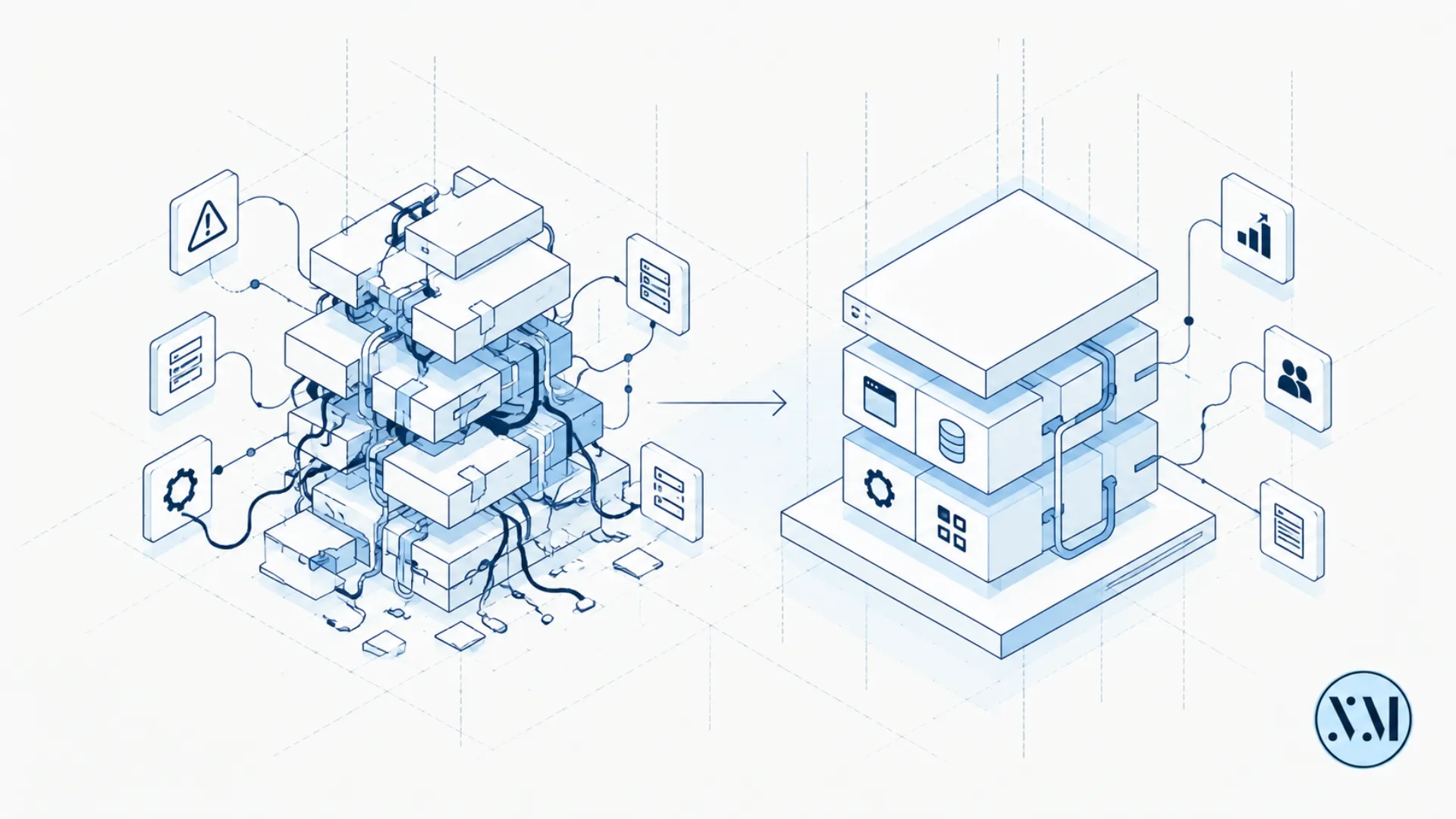
Technical Debt Is Not Just a Developer Problem
Technical debt eventually becomes a business problem. Learn how fragile systems, undocumented decisions, and difficult maintenance can create costs long after the original shortcut.

Technical debt sounds like something developers should worry about.
Business owners have more important things to think about.
Clients.
Employees.
Sales.
Cash flow.
Operations.
But technical debt eventually becomes a business problem.
Usually at the worst possible time.
What technical debt actually means
Technical debt is the future cost created by technical decisions made today.
Sometimes the decision is deliberate.
A team chooses a quick implementation because speed matters.
That is not necessarily wrong.
The problem comes when the consequences are ignored.
Other times, technical debt is accidental.
A website grows without a clear structure.
Plugins accumulate.
Integrations are added one at a time.
Nobody documents how anything works.
A workaround becomes permanent.
Eventually, making a small change becomes surprisingly difficult.
The symptoms are often familiar
You may have technical debt if:
- nobody wants to touch the website
- every change requires a developer
- one person's departure creates a major knowledge gap
- plugins depend on one another
- integrations break unexpectedly
- simple features require complicated workarounds
- the system has become difficult to explain
- nobody knows why certain decisions were made
- maintenance takes longer than expected
None of these automatically means your system is badly built.
But they are signals worth investigating.
Technical debt has an interest rate
Imagine a business needs to change a website form.
In a well-structured system, that might take thirty minutes.
In a fragile system, it might require investigation, testing, plugin updates, custom fixes and deployment work.
The original shortcut has now created an ongoing cost.
That is the "interest" on technical debt.
The longer the underlying problem remains, the more expensive certain changes can become.
Not all technical debt needs to be eliminated
This is important.
Trying to eliminate every form of technical debt is unrealistic.
Businesses have budgets.
Priorities change.
Sometimes a temporary solution is exactly the right decision.
The question is whether the debt is understood.
A useful distinction is:
Known and managed debt versus unknown and accumulating debt.
The first can be a reasonable business decision.
The second is dangerous because the business does not know what it is carrying.
How business owners can reduce it
You do not need to become a software engineer.
Start by asking simple questions.
Can someone else understand how this works?
Can we change it without rebuilding everything?
Do we know what happens if this service stops working?
Are important processes dependent on one person?
Do we have unnecessary plugins, subscriptions or integrations?
Is there a simpler way to achieve the same result?
These questions are surprisingly powerful.
Documentation is part of the system
Documentation is sometimes treated as administrative overhead.
For important systems, it is infrastructure.
Someone should be able to understand:
- what the system does
- which tools are involved
- who owns them
- what depends on what
- where important data lives
- how common changes are made
- what happens when something fails
This reduces operational dependency on individual people.
Build systems that can be maintained
The real objective is not to avoid every technical problem.
It is to create a business where technology remains understandable.
A good digital system should not require its owner to be an engineer.
It should be possible to maintain, explain, improve and eventually replace.
Technology changes.
People change.
Businesses change.
The systems supporting them need to survive those changes.
That is why maintainability is not merely a technical quality.
It is a business quality.