
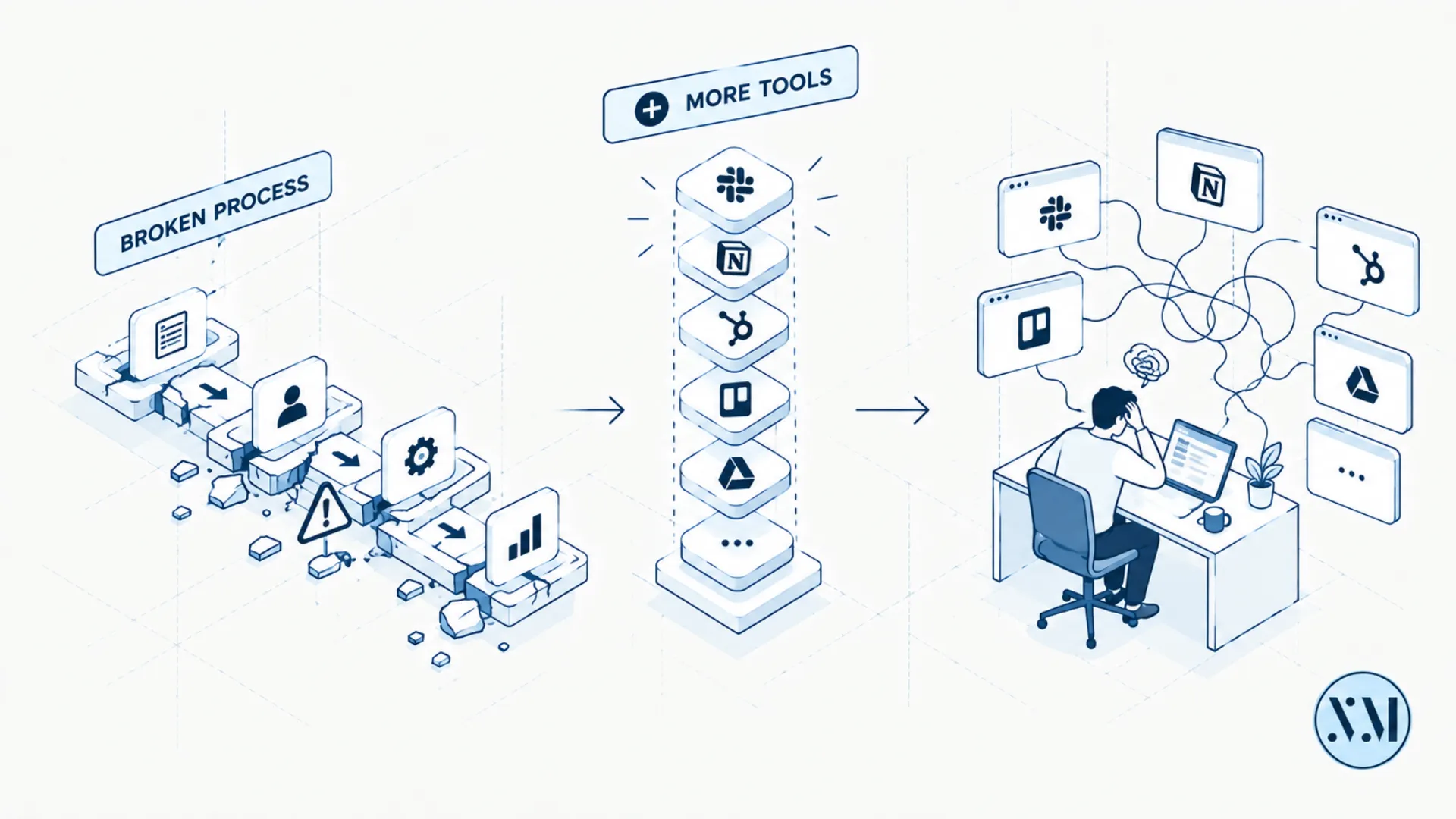
Why Adding More Tools Rarely Fixes a Broken Process
New software cannot fix a process nobody has properly defined. Before adding another tool, understand the workflow, ownership, handoffs, and decisions involved.

When something is going wrong, adding software feels productive.
The team is missing follow-ups.
Buy a CRM.
Tasks are being forgotten.
Add an automation tool.
Information is scattered.
Add another database.
The problem is that software cannot compensate for an undefined process.
Tools amplify processes
A clear process supported by good software can become efficient.
An unclear process supported by good software can become complicated.
Consider a simple example.
A business receives enquiries.
Nobody has agreed who qualifies them.
Nobody has defined how quickly they should be contacted.
Nobody knows what information should be collected.
The business buys a CRM.
Now all of those problems exist inside a CRM.
The software did not fail.
The process was never defined.
Define the desired outcome first
Before selecting a tool, describe the process in plain language.
For example:
When a qualified enquiry arrives, the responsible person should receive the information they need, contact the prospect, record the outcome and create the next action.
That sentence is more valuable than a list of software features.
Now you can determine what the technology needs to support.
Look for ambiguity
Broken processes often contain unclear decisions.
Who owns this?
What happens next?
When should this happen?
What information is required?
What counts as complete?
What happens if the customer does not respond?
These questions should be answered before automation is introduced.
Reduce handoffs
Every handoff introduces risk.
Customer → salesperson.
Salesperson → operations.
Operations → finance.
Finance → customer.
If information is repeatedly passed from person to person, opportunities for loss increase.
Good systems make ownership and transitions visible.
Use software to support the process
Once the process is clear, technology becomes useful.
The CRM can become the source of truth.
The form can collect structured information.
The workflow can create tasks.
The automation can send notifications.
The dashboard can show status.
Each component has a purpose.
That is much better than buying software first and trying to invent a purpose for it afterward.
Sometimes the answer is less technology
You may discover that the best solution is:
- removing a step
- changing ownership
- using one shared system
- replacing a spreadsheet
- simplifying a form
- documenting a process
None of these sound particularly exciting.
They can still create substantial improvement.
Technology is a means.
The process is the thing that matters.