
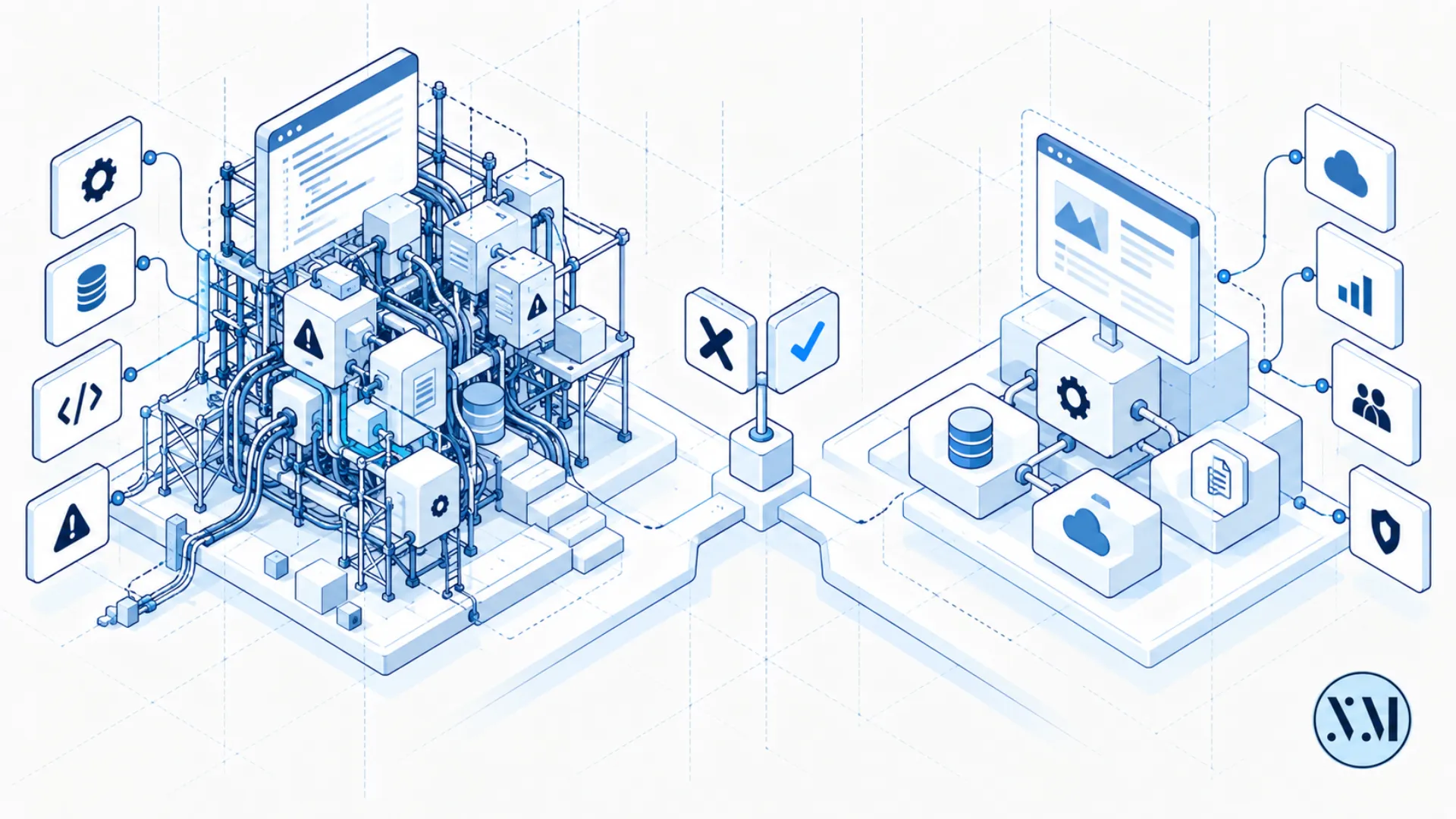
Why "Custom" Does Not Automatically Mean Better
Custom software can solve unique problems, but it also creates ongoing responsibility. Learn when building makes sense—and when an existing solution is the better choice.

Custom software sounds attractive.
It will work exactly the way the business wants.
No unnecessary features.
No limitations.
No compromise.
Sometimes that is true.
Sometimes custom software is simply a very expensive way to recreate something that already exists.
Start with the requirement
The right question is not:
"Should we build custom software?"
Ask:
"What does the business actually need that existing solutions cannot reasonably provide?"
That is a much better starting point.
Software is a tradeoff
Every option has tradeoffs.
A SaaS product may be faster to implement but less flexible.
A custom application may provide greater control but require ongoing development.
A spreadsheet may be extremely flexible but weak in collaboration and automation.
A CMS may be excellent for content but inappropriate for complex operational workflows.
There is no universally correct option.
Custom software has ongoing costs
Building the first version is only the beginning.
Someone needs to maintain it.
Security needs attention.
Dependencies change.
Users need support.
Features evolve.
Infrastructure costs money.
Developers need to understand the system.
That does not make custom software bad.
It simply means the total lifecycle matters.
Build when the difference matters
Custom development becomes more compelling when the business has requirements that materially affect its operation.
For example:
- unusual workflows
- proprietary processes
- specialized data structures
- important integrations
- unique customer experiences
- requirements existing software cannot reasonably support
Even then, start small.
Build the smallest useful system.
Learn from actual usage.
Expand only when the need is demonstrated.
Buy when the problem is already solved well
There is no prize for rebuilding commodity functionality.
If an existing product reliably handles:
- scheduling
- payments
- accounting
- standard CRM functions
there may be little value in recreating it.
The business's competitive advantage rarely comes from reinventing commodity infrastructure.
The right question is fit
The goal is not:
Buy everything.
It is not:
Build everything.
It is:
Choose the simplest architecture that solves the actual problem well.
That requires judgment.
And sometimes the most sophisticated decision is choosing not to build.